

Vacancies are up 27%. Salaries are down 15%. AI is reshaping the role from the bottom up. Here’s the data every business analyst in the UK needs to see right now.
If you’re a business analyst in the UK or trying to become one, the job market in early 2026 is sending some genuinely mixed signals. Job postings are recovering. Salaries have dropped sharply. AI is changing what employers actually want. And entry-level? It’s quietly getting squeezed.
I’ve pulled together the latest figures from IT Jobs Watch, Glassdoor, Lightcast, and PwC’s 2025 AI Barometer to give you a clear-eyed picture of where things stand. No spin, no hype, just the data, and what to do with it.
The market is growing - but unevenly
Let’s start with the headline: there are more BA jobs being advertised than this time last year. In the six months to January 2026, 970 permanent BA vacancies were posted in the UK - a 27% jump from 763 in the same period the year before. On Glassdoor alone, 1,243 BA roles are currently open.
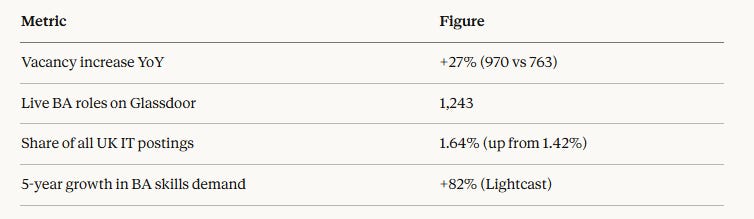
So far, so encouraging. But here’s the catch: BA roles peaked at 2.20% of all IT postings in 2024, then fell sharply before this recovery. The market contracted hard and is only now clawing back. That context matters if you’re reading the “27% up” figure and feeling optimistic.
Salaries: A surprising drop at the median
This is where the picture gets complicated. Despite more vacancies, median salaries have fallen. The current median permanent BA salary in the UK is £55,000 - down from £65,000 in the same period last year. That’s a 15.4% decline in twelve months.
“More jobs, lower pay, classic signs of a market where supply of candidates has outpaced demand. For BAs, this signals more competition at the same wage point.”
The salary breakdown by seniority:
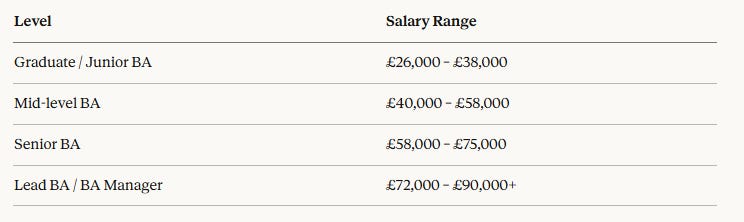
The geography gap is striking. London BAs earn a median of £76,750, versus just £44,500 in Yorkshire, a 53% premium for the same job title. Remote roles are pulling a surprising £63,395, well above the national median and just below London.
For contractors: the market remains solid at a median rate of £500/day, with financial services and large IT transformation programmes commanding the most.
Entry-Level: The squeeze is real
If you’re trying to break into BA work, 2026 is harder than it looks. Yes, there are 1,449 entry-level BA vacancies listed on Glassdoor, but the conditions for landing one have quietly worsened.
The 10th percentile salary, the floor of the market, has collapsed from £40,100 to £28,250 in a single year. That means the worst-paying BA roles are paying significantly less, which affects graduates and career-changers disproportionately. Junior postings are also down 15% year-on-year across AI-exposed white-collar sectors.
Employers are raising the bar on what they expect from junior hires, partly because AI tools are now doing what entry-level analysts once did: gap analysis, requirements drafting, process documentation. Certifications like the BCS International Diploma or the IIBA’s ECBA are increasingly used as differentiators in a crowded applicant pool.
The AI factor: What’s actually happening to BA jobs
This is the most important section in this article. AI isn’t killing the BA role, but it is transforming it from the ground up.
Demand is shifting upward. After the launch of large language models in 2022–23, job postings for roles involving repetitive, structured tasks dropped 13%. Meanwhile, demand for analytical and technical roles grew 20%. Basic BA work, documentation, requirements gathering, process mapping are being automated. Strategic BA work is being amplified.
There’s a real AI skills premium. PwC’s 2025 Global AI Jobs Barometer found a 56% wage premium for roles requiring AI skills. UK job postings mentioning AI pay roughly 3–15% more depending on specificity. Job descriptions referencing AI have surged 400% over two years.
Displacement is real but not catastrophic. Experts project 5–10% net job displacement once new job creation is factored in. Around 40% of global employers say they expect to reduce headcount in areas where AI automates tasks in 2026. The BAs most at risk are those doing narrow, repeatable work with no strategic overlay.
New adjacent roles are emerging. Automation consultants, AI ethicists, machine learning project leads, these are roles BAs are naturally positioned to move into, given their blend of stakeholder management, process thinking, and analytical skills.
So what should you actually do?
The data paints a market in genuine transition. Here’s how to position yourself for that reality.
1. Get AI-literate, not just AI-aware. Learn to use tools like Copilot, Claude, or Gemini to accelerate your actual BA workflows - requirements synthesis, user story drafting, gap analysis. Put it in your CV and mean it.
2. If you’re entry-level, certify. The BCS International Diploma in Business Analysis and the IIBA ECBA are both respected and increasingly expected. They signal seriousness in a market where junior postings are down 15%.
3. Consider going contract if you have 3+ years’ experience. The £500/day contractor median is robust. With permanent salaries compressing, experienced BAs have real leverage in the gig market, especially in financial services and public sector transformation.
4. Don’t ignore remote-listed roles. Remote BA jobs are paying a median of £63,395, well above the national permanent median of £55,000. If you’re outside London, this is the lever that most evens the playing field.
5. Develop strategic, not just technical, skills. If your value is mostly in documentation and process mapping, you’re exposed. Lean into stakeholder influence, commercial acumen, and strategic problem-framing.
6. Watch the analytics adjacency. Business analytics skills have grown 82% in demand over five years. If you can bridge into data literacy, SQL, or BI tooling (Power BI, Tableau), you open a much wider aperture of roles and the salary bands are meaningfully higher.
The BA role isn’t disappearing. The strategic version of it, the BA who understands the business, influences decisions, and knows how to work with AI rather than against it, is more valuable than ever. The market is just being more selective about who gets to play that role.
If you’re navigating this market right now, the numbers are on your side, as long as you’re moving with them, not waiting for them to move for you.
Data sources: IT Jobs Watch (Jan 2026), Glassdoor (March 2026), Lightcast, PwC Global AI Jobs Barometer 2025, Gartner, World Economic Forum.
This was a really helpful read. The tips are practical and apply beyond BA roles too.