

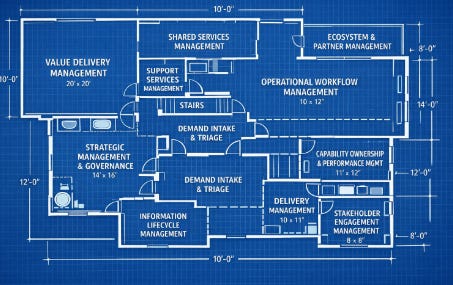
Imagine commissioning a master builder to construct your dream home but handing them no architectural drawings, no site survey, no structural calculations. Just an enthusiastic brief: “Make it big, make it beautiful, and make it work.” What you’d get, eventually, would be walls that don’t meet, wiring that contradicts the plumbing, rooms nobody can find, and a staircase that leads nowhere useful. You would spend more money rectifying problems than you ever did building them. Improbable? In construction, yes. In business transformation? It happens every single day.
This is the paradox at the heart of modern enterprise: organisations pour billions into strategy, technology, and change, and then wonder why the results fall short of the vision. The missing ingredient, more often than not, is a coherent Business Architecture. Not a diagram on a wall. Not a dusty strategy document. A living, structured, cross-organisational blueprint that tells everyone from executives to process owners and project teams exactly what the business is, how it works, what it needs, and where it is going.
This article is a case for that blueprint. And to make it tangible, we’re going to build a house.
— ✦ —
Before the first brick: What is Business Architecture?
Business Architecture is the formal practice of describing an enterprise, its strategy, capabilities, value streams, information, and organisational structure, in a way that creates a shared, navigable understanding of how everything connects. It is, in the truest sense, the architectural drawings of a company.
A well-formed Business Architecture answers four fundamental questions:
Where are we going? The strategic intent: vision, goals, and the operating model needed to fulfil them.
What do we do? The capabilities and value streams that deliver outcomes to customers and stakeholders.
How do we do it? The processes, information flows, people, and systems that animate those capabilities.
What do we have and what do we need? The gap between the current state and the future state, expressed as a roadmap for change.
Without these answers, every project starts from scratch. Every business analyst re-discovers the same terrain. Every technology investment is justified in isolation. And every transformation hits the same hidden walls.
A business without architecture is not just inefficient, it is structurally blind. It cannot see itself clearly enough to change itself deliberately.
Building the house: The architecture analogy
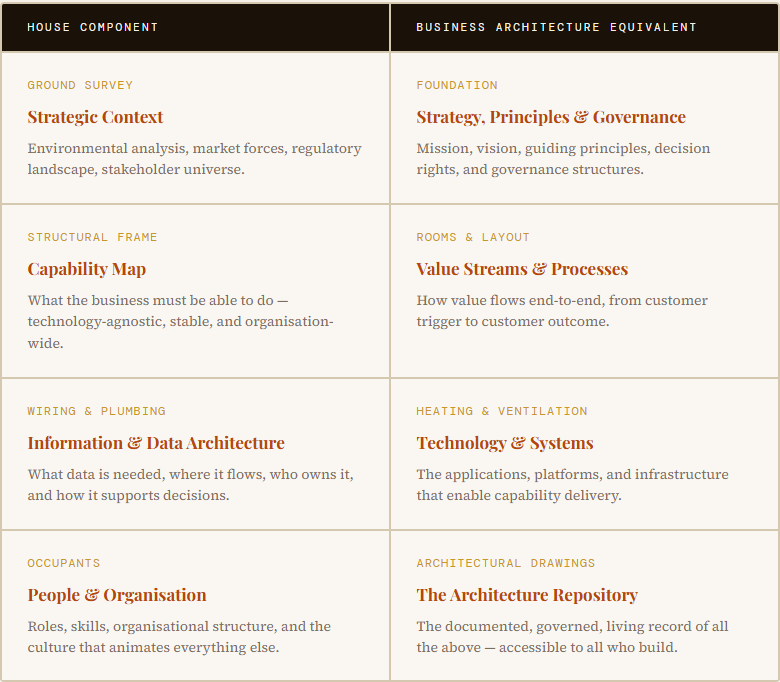
Let’s construct our house......and our business, component by component. The parallels are not metaphorical decoration; they are structurally precise. Every layer of a well-built house corresponds to a layer of business architecture, and every shortcut taken in one creates exactly the kind of catastrophe you’d expect in the other.
The ground survey - Environmental & strategic context
No architect breaks ground without a thorough survey of the land. What are the soil conditions? What are the planning regulations? What utilities run beneath the surface? What are the prevailing winds and water tables?
In Business Architecture, this is the strategic context: the competitive environment, regulatory landscape, customer expectations, technological trends, and organisational history. A mature architecture practice begins here, with structured environmental scanning, stakeholder mapping, and strategic intent documentation. Skipping the survey means you build on assumptions. And assumptions, like unstable ground, collapse under load.
The Foundation - Strategy, principles & governance
The foundation of a house bears every load that sits above it. It is invisible once built, rarely admired, and catastrophically expensive to fix after the fact. Its quality determines whether the structure stands for a decade or a century.
In Business Architecture, the foundation is strategy, guiding principles, and governance frameworks. These are the non-negotiables: the mission the organisation exists to fulfil, the values that constrain how it pursues that mission, and the decision rights that determine who can authorise what. A weak foundation, ambiguous strategy, contradictory principles, absent governance, means every floor above it cracks. Projects pull in different directions. Investments contradict each other. Business analysts are left resolving political tensions that should have been resolved in the boardroom years earlier.
When the foundation is solid and explicit, it becomes the single most powerful accelerator in the business analyst’s toolkit. Every requirements decision, every scope boundary, every trade-off can be traced back to it. Stakeholder disagreements that would otherwise consume weeks of workshops are resolved in hours because the foundation provides the answer.
The structural frame - Business capabilities
The structural frame is what gives a building its shape and load-bearing integrity. It is distinct from the rooms within it. It is the skeleton around which everything else is organised. Change the frame and you change the building. Understand the frame and you understand what is and isn’t possible to build inside it.
The equivalent in Business Architecture is the Business Capability Map, a structured, technology-agnostic view of what the organisation must be able to do to deliver its value proposition. “Manage Customer Relationships.” “Process Claims.” “Optimise Supply Chain.” “Develop Talent.” These are capabilities, not processes, not systems, not organisational units. They are stable over time even as the processes and systems beneath them change.
The capability map is perhaps the single most transformative artefact a business architecture team can produce. It creates a shared language across the organisation. It provides a rational basis for investment prioritisation. It exposes duplication and gaps. And it gives business analysts a precise map of the terrain before they begin any piece of work, dramatically reducing the time spent establishing scope and context.
The rooms & layout - Value streams and processes
A well-designed floor plan flows intuitively. The kitchen connects logically to the dining room. The master bedroom has its own bathroom. The utility room is near the entrance. Nobody has to think hard about how to move through the space. The layout itself communicates intent and enables natural behaviour.
In Business Architecture, value streams are the floor plans. They describe end-to-end flows of activity that deliver value to a customer or stakeholder, from the triggering event (a customer places an order) to the outcome (the customer receives their goods and a delightful experience). Beneath the value streams sit the process architectures: the detailed room-by-room layouts that define exactly what happens, by whom, and in what sequence.
A business analyst working within a documented value stream architecture knows, before they begin requirements gathering, which stakeholders own each stage, what the handoff points are, where the pain tends to cluster, and how any change they introduce will ripple upstream and downstream. This is not a luxury. It is the difference between analysis that takes three months and analysis that takes three weeks.
Wiring & Plumbing - Information architecture
Any seasoned builder will always tell you that the most expensive mistakes in construction are always in the services, the wiring and plumbing that run invisibly through walls and floors. Install them wrong and you face breaking finished surfaces to fix what lies beneath. Install them right and they are completely invisible, simply enabling everything above them to function without friction.
The Information Architecture is the wiring and plumbing of the business. It defines what data the organisation creates, uses, and is responsible for; how that data flows between capabilities and systems; where the authoritative sources of truth reside; and what information is needed to make which decisions. A mature information architecture means a business analyst can immediately identify what data is available to support a new process, where data quality issues exist, and what information gaps need to be closed before a capability can be delivered. Without it, every project rediscovers the same data problems independently, and usually too late.
The heating, lighting & systems - Technology architecture
Modern buildings are defined as much by their systems as their structure. The HVAC, the electrical grid, the smart home technology, these are not afterthoughts but integral parts of the design. They are specified to serve the building’s purpose and fitted to the structure, not the other way around.
Technology architecture in a business works identically. Applications, platforms, and infrastructure exist to serve business capabilities, not to define them. A Business Architecture that is properly constructed makes this explicit: each technology component is mapped to the capability it enables, and investment decisions are evaluated on the basis of capability impact. This is the foundational shift that separates organisations that modernise coherently from those that accumulate technical debt in perpetuity.
Key Insight
Technology architecture that is not anchored to business capabilities is like installing a five-zone underfloor heating system before deciding how many rooms the house will have. Impressive, expensive, and almost certainly in the wrong place.
The occupants - People, culture & organisation
A house is ultimately defined by those who live in it. The most brilliantly designed structure becomes dysfunctional if the people inside it don’t know how to use it, or if its design ignores how they actually live. The best architects design with the occupants in mind, not around an abstract ideal of a perfect house.
Business Architecture must account for the human dimension: the roles, skills, and competencies required to run each capability; the organisational structures that distribute accountability; and the culture and behaviours that determine whether designed processes are actually followed. A business analyst who has access to an organisational capability heat map, knowing which capabilities are well-staffed and high-performing, and which are fragile, under-resourced, or culturally resistant to change, can make better recommendations, more realistic estimates, and more honest assessments of delivery risk.
— ✦ —
The blueprint in practice: How architecture enables analysis
So far, we have built the house. Now let’s watch what happens on a building site where the blueprints are always on the table, versus one where every tradesperson arrives with only a vague verbal brief and their own interpretation of the design.
In organisations with mature Business Architecture, the transformation in how analysis work unfolds is profound and immediate:
Scope is defined, not negotiated from scratch. A business analyst begins a new initiative with a pre-existing capability map, value stream map, and process hierarchy. Scope is agreed by reference to the architecture, not reconstructed through exhausting rounds of stakeholder workshops. What used to take six weeks takes six days.
Requirements land in context. Every requirement can be placed within a capability, connected to a value stream stage, and evaluated against strategic principles. Ambiguous requirements are resolved by reference to the architecture. Gold-plating is identified early because it sits outside the architectural boundaries.
Impact assessment becomes systematic. Change impact analysis, previously an art form reliant on individual knowledge and institutional memory, becomes a structured exercise. The architecture shows exactly what is connected to what. No more surprise dependencies discovered in UAT.
Duplicated effort is eliminated. Business analysts working across different programmes recognise when they are working on the same capability and share their findings. Solutions designed for one part of the business are reused in another. This is not coincidence, it is architecture-enabled visibility.
Stakeholder alignment happens faster.When everyone uses the same capability language, cross-functional conversations become dramatically more productive. The business analyst is no longer the translator between fiefdoms, the architecture is the common map everyone navigates together.
Strategic alignment is traceable and defensible.Every project, every requirement, every recommendation can be traced back to a strategic objective via the architecture. This is invaluable in governance forums and investment committees, and transformative in building the credibility of the analysis function.
Business Architecture does not constrain the business analyst, it liberates them. It turns an act of exploration into an act of navigation. You still travel the same terrain, but now you have the map.
The Cost of Building Without Blueprints
For those who remain sceptical, who believe that Business Architecture is an academic exercise for large consultancies, it is worth being precise about what organisations actually pay when they build without blueprints.
They pay in rework: solutions built on misunderstood requirements, rebuilt when the misunderstanding surfaces in production. They pay in duplication: four different teams solving the same problem independently, none aware of the others. They pay in integration failure: systems that cannot talk to each other because nobody mapped the information flows before procurement. They pay in change fatigue: transformations that restructure the organisation without understanding the capabilities that need to change, generating disruption without improvement. They pay in strategic drift: portfolios of projects that each made local sense but collectively move the organisation sideways.
These are not theoretical risks. They are the dominant pattern in enterprise transformation. The architecture community has a name for the accumulation of these costs over time: organisational debt. And like technical debt, it compounds.
Starting to build: Where to begin
The most common objection to Business Architecture investment is the perceived scale of the undertaking. “We can’t afford to map the entire business before we start delivering.” This is the wrong framing, and it’s worth correcting directly.
You do not need a complete architecture before you can begin extracting value. You need a sufficient architecture, one that covers the domains most relevant to your immediate portfolio and provides enough context to improve decision-making. Begin with a high-level capability map. Connect it to your strategy. Identify your most critical value streams. Document the information that flows through them. These four artefacts, produced to a useful level of fidelity, will immediately transform the effectiveness of your business analysis practice.
Then grow the architecture alongside the work. Let each initiative contribute new detail. Let the business analysts who discover new patterns feed them back into the repository. Make the architecture a living document, owned not by a distant architecture team in an ivory tower, but by the practitioners who use it every day.
The best Business Architecture practices are not built in isolation by architects, they are built collaboratively, with business analysts as the primary contributors and primary users. When analysts both inform and consume the architecture, it stays accurate, relevant, and genuinely useful.
— ✦ —
The House Stands
Return, finally, to the house. The one built with blueprints, proper survey, structural calculations, and coordinated trades. The plumber knows where the electrician has run conduit. The joiner knows where the structural engineer has placed the load-bearing walls. The interior designer works with the architect’s floor plans, not against them. Everyone builds towards the same resolved vision, and the result is a structure that does what it was designed to do, efficiently, coherently, and for a long time.
This is what a well-formed Business Architecture creates. Not a constraint on creativity or a brake on speed, but the conditions under which good work becomes great work, and great work accumulates into lasting organisational capability.
Business analysts who work within a mature architecture are not limited by it. They are elevated by it. Their analysis is sharper, their recommendations more credible, their delivery faster, and their impact deeper. They spend less time establishing context and more time creating insight. Less time negotiating scope and more time designing solutions. Less time resolving conflicts and more time building consensus.
The blueprint does not replace the craft. It makes the craft possible at its highest level.
Every house worth living in began as lines on paper. Every business worth building deserves the same.
References: Business Architecture Guild® BIZBOK® Guide (v13), The Open Group TOGAF® Standard, 10th Edition (2022), IIBA BABOK® Guide, Version 3.0 (2015), Ulrich, W. & McWhorter, N. Business Architecture: The Art and Practice of Business Transformation (2010), Porter, M.E. Competitive Advantage, Free Press (1985), Osterwalder, A. & Pigneur, Y. Business Model Generation, John Wiley & Sons (2010), Martin, K. & Osterling, M. Value Stream Mapping, McGraw Hill (2014)